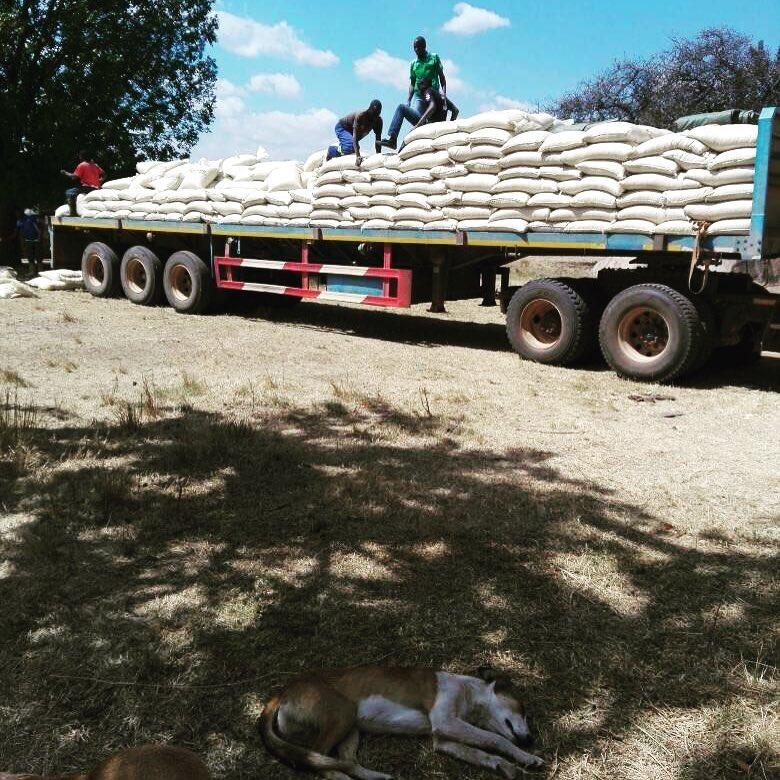
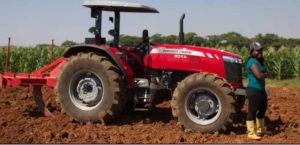
 The tractor has enhanced productivity for Ruramiso in Zimbabwe.[/caption]
The money from financing, of course, is just a means to an end. What we really need is technology. That's what we want to spend the money on.
Technology multiplies the effect of our labor, making us more efficient and productive as we work the land. It allows us to upscale our operations, as we move from smallholder farming to commercial agriculture.
I've seen the difference technology has made on my own farm. When I acquired an 80-hp tractor, our ability to grow crops was transformed. The addition of storage and cooling facilities helped us cut down on the post-harvest losses that imperil African food security.
I'm optimistic about the future of African agriculture. We have underperformed for a long time, compared with the rest of the world. In Zimbabwe, our national yields have dropped for three years in a row. Other sub-Saharan countries have suffered similar problems.
We have a lot of catching up to do.
Some people may see this as an insurmountable challenge. I see something different: a remarkable opportunity to get more from the land. As we turn our small farms into commercial enterprises, we have a chance to develop and grow and do much better.
[caption id="attachment_42721" align="alignleft" width="351"]
The tractor has enhanced productivity for Ruramiso in Zimbabwe.[/caption]
The money from financing, of course, is just a means to an end. What we really need is technology. That's what we want to spend the money on.
Technology multiplies the effect of our labor, making us more efficient and productive as we work the land. It allows us to upscale our operations, as we move from smallholder farming to commercial agriculture.
I've seen the difference technology has made on my own farm. When I acquired an 80-hp tractor, our ability to grow crops was transformed. The addition of storage and cooling facilities helped us cut down on the post-harvest losses that imperil African food security.
I'm optimistic about the future of African agriculture. We have underperformed for a long time, compared with the rest of the world. In Zimbabwe, our national yields have dropped for three years in a row. Other sub-Saharan countries have suffered similar problems.
We have a lot of catching up to do.
Some people may see this as an insurmountable challenge. I see something different: a remarkable opportunity to get more from the land. As we turn our small farms into commercial enterprises, we have a chance to develop and grow and do much better.
[caption id="attachment_42721" align="alignleft" width="351"]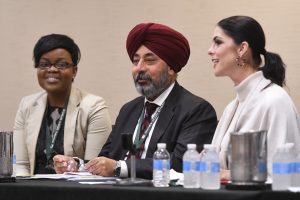 Ruramiso on side panel during 2016 World Food Prize with fellow GFN member PPS Pangli (India) and moderator Julie Borlaug.[/caption]
Women are essential to this project. In Zimbabwe today, seven out of every ten farmers is a woman on a small-scale farm.
We'll start with the basics of finance and mechanization. Then, we'll move on to other technologies, such as advanced storage facilities that will fight spoilage.
We're also ready to embrace genetic modification. It has revolutionized agriculture everywhere it's been tried, including right across our southern border in South Africa.
We haven't tried GMOs in Zimbabwe yet, as our country currently doesn't allow them. Opposition to this safe and proven technology won't last forever, though, because the advantages are so obvious. GMO maize that resists pests like the stalk borer are essential to our future, along with drought resistance and higher yields.
When I'm not farming, I'm trying to spread this message of hope and aspiration, in the belief that other young women will take up the call to look at farming as a business that deserves financing and to treat technology as a friend who can enable growth.
One day, the idea of an enterprising, successful woman in farming won't seem so strange. We'll be ordinary.
Ruramiso on side panel during 2016 World Food Prize with fellow GFN member PPS Pangli (India) and moderator Julie Borlaug.[/caption]
Women are essential to this project. In Zimbabwe today, seven out of every ten farmers is a woman on a small-scale farm.
We'll start with the basics of finance and mechanization. Then, we'll move on to other technologies, such as advanced storage facilities that will fight spoilage.
We're also ready to embrace genetic modification. It has revolutionized agriculture everywhere it's been tried, including right across our southern border in South Africa.
We haven't tried GMOs in Zimbabwe yet, as our country currently doesn't allow them. Opposition to this safe and proven technology won't last forever, though, because the advantages are so obvious. GMO maize that resists pests like the stalk borer are essential to our future, along with drought resistance and higher yields.
When I'm not farming, I'm trying to spread this message of hope and aspiration, in the belief that other young women will take up the call to look at farming as a business that deserves financing and to treat technology as a friend who can enable growth.
One day, the idea of an enterprising, successful woman in farming won't seem so strange. We'll be ordinary.
This post originally ran 9/13/17.