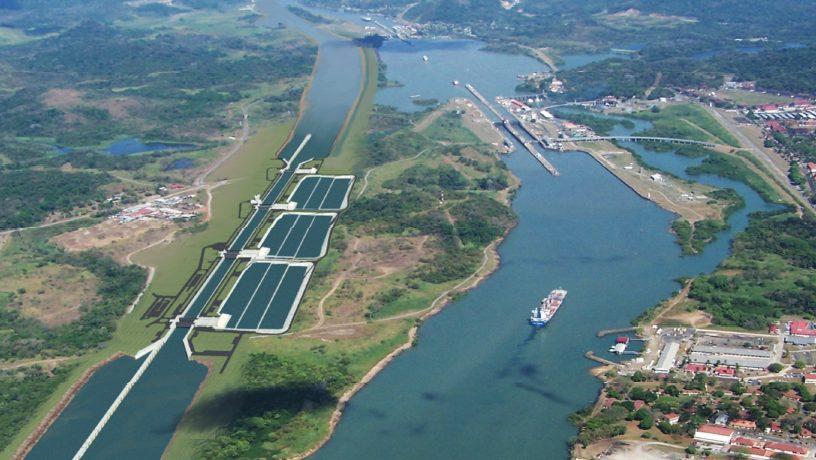
Perhaps the recent fuss over the Panama Canal will deliver one worthy result: U.S. Navy ships won’t have to pay a fee to move through the isthmus that divides two oceans.
If that’s the outcome of the rhetorical war launched by President Trump, then the United States should take the win—and move on from a low-stakes skirmish over the canal and turn its attention to securing trade deals that will help farmers and others.

I’ve visited the Panama Canal three times, always with agricultural groups whose goal was to understand the workings of this artificial waterway. I’ve traversed it as a passenger, observed it from shore with engineers, and studied it with the eye of a farmer who appreciates the importance of international trade.
It’s an amazing structure of dams and locks that allows big ships to avoid long voyages around the tip of South America. It lets them take a shortcut that saves weeks of transportation costs for producers and consumers alike. It even fights climate change because it allows ships to save fuel, reducing greenhouse-gas emissions.
The American Society of Civil Engineers rates the Panama Canal as one of the modern “wonders of the world.”

Although my farm is thousands of miles to the north in landlocked Iowa, I depend on the canal. Some of the corn and soybeans that I grow floats down the Mississippi River and eventually makes the 51-mile passage across Central America and into the Pacific Ocean, on the way to customers I’ll never meet.
The Panama Canal helps all U.S. farmers engage in global commerce.
Nearly 10,000 ships passed through the canal in 2024, and they carried everything from cars and coal to containers full of consumer items. These journeys connected 1,920 ports in 170 countries, according to the Panama Canal Authority.
The United States was the biggest user, with 163 million tons of cargo in the 12-month period that ended last September, reports the BBC. China came in second, with 46 million tons. Japan, South Korea, Mexico, Chile, and Peru followed.
In January, however, President Trump announced his displeasure with the Panama Canal, claiming in his inaugural address that China runs it and American ships pay too much when they move through it.
“Fiction has ruled the U.S. narrative,” wrote Mary O’Grady in the Wall Street Journal last week.
Yet President Trump’s remarks also contained elements of truth. A Hong Kong-based company operates a couple of the canal’s ports. While it currently appears to function without interference from Beijing, that could change during a conflict. In addition, U.S. ships pay the same as ships from other nations—but this includes U.S. naval vessels, which is odd because the United States is obligated by treaty to defend the canal from enemy attack.
Why should U.S. warships that protect the canal also pay a fee to use the canal?
They may not in the future. Secretary of State Marco Rubio said earlier this month that he expects the canal to halt these charges (though the details of a potential agreement are in dispute). What’s more, the government of Panama has announced that it will limit Chinese infrastructure investments.
These are victories for the United States—and my hope is that President Trump will accept them and move on to other matters involving trade.
Since his inauguration, President Trump has focused on raising tariffs, which reduce trade opportunities. I’m with Sen. Charles Grassley of Iowa. In a recent television interview, he advised a “wait-and-see attitude.” If Trump succeeds with his plans, we can compliment him for his achievements. And if not, we can say: “I told you so.”
Regarding the Panama Canal, I’m ready to compliment President Trump. It’s crazy that the U.S. Navy has ever paid a penny to use the canal.
I’ve also seen enough.
Arguing about the canal is a distraction. The canal works well and serves our interests. It’s time to pursue authentic trade opportunities.