When we saw Pope Francis on a visit to the Vatican in October, we were surprised and humbled by the large number of people in wheelchairs who were also in his presence. It was moving to see the pope pray for their wellbeing, reminding us of the church’s mandate.
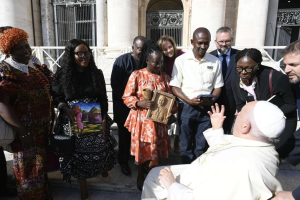
The experience brought to mind the
passage in the Gospel of John when Jesus goes up to Jerusalem and meets the “ill, blind, lame, and crippled.” He tells one of them: “Rise, take up your mat, and walk.” And that’s what the man does, in a story that shows the healing power of faith.
Neither one of us is Catholic, but we’re both Christian—and it was humbling to attend a Mass at St. Peter’s in the Vatican. The people are devout, the buildings are beautiful, and it was a treat to see the pope ride in the “
Popemobile.”
We came to Rome as African farmers—one of us from Nigeria, and one from Zimbabwe.
Our purpose was to participate in a roundtable sponsored by the Pontifical Academy for Life and hosted by the
Pontifical Academy of Sciences, which is the scientific arm of the Roman Catholic Church. “Its mission is to honor pure science wherever it may be found, ensure its freedom, and encourage research for the progress of science,” according to its
website.
The academy shares an observation of Pope Francis: “Today’s scientists are more open to religious values and can glimpse the richness of the spiritual world and the light of divine transcendence.”
That’s good news, and our message at the roundtable in Rome was similar: Today’s African farmers are more open to scientific values and can glimpse the promise of technology and the prospect of food security.
We’re ready to rise up and walk, figuratively speaking.
Our hope is that the Vatican will use its massive influence in Africa and throughout the world to realize this vision. By promoting science, the Roman Catholic Church can help African farmers gain the tools we need to feed our continent.
In what is now the Christmas season, we believe that this will advance the Christian causes of peace on earth and goodwill toward men.
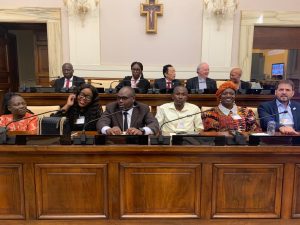
The African farmer roundtable sought to call attention to the many challenges that African farmers face—and to highlight solutions. These include the adoption of no-till farming to enhance and protect the soil as well as the peer-to-peer knowledge transfer that can help Africans improve our agriculture.
The most important step, however, involves access to technology. African farmers, especially smallholders, don’t have enough of it. Farmers in much of the developed world take advantage of the latest benefits of crop science. They’re fighting pests, disease, and drought. They’re growing more food than ever before and they’re doing it on less land, through a marriage of sound science and modern technology.
Yet many African governments have resisted these innovations. For too long, they’ve taken their cues from the European Union and international non-profit groups that have lobbied against agricultural policies based on scientific reasoning. The bad result is that few African farmers can plant biotech crops, which are now a conventional part of agriculture in so many other countries.
We believe this is starting to change. Public officials and ordinary people in Africa are becoming more open to new technologies, especially as Africa’s farmers continue to trail the rest of the world in food production. We’ve recently seen the adoption of better policies in
Kenya, for example.
Yet we still have far to go—and that’s why the Vatican is such an important ally.
More than 1 billion people live in sub-Saharan Africa. Nearly two-thirds of them are
Christian, including more than 171 million
Catholics.
Years ago, the Pontifical Academy of Sciences gave its
blessing to GMOs. The more Africans know about the pro-science views of the Roman Catholic Church, the more they’ll embrace the crop technologies that farmers need. We have a duty to spread the word, and we hope the Vatican will help. More roundtables like the one we just enjoyed would be a positive step.
Our wish is for an African agriculture that is resilient, has the capacity to feed itself and become food secure. To witness a prosperous Africa catalyzed by agricultural advancement.
For more people to know the truth about faith and science—and have faith in science.