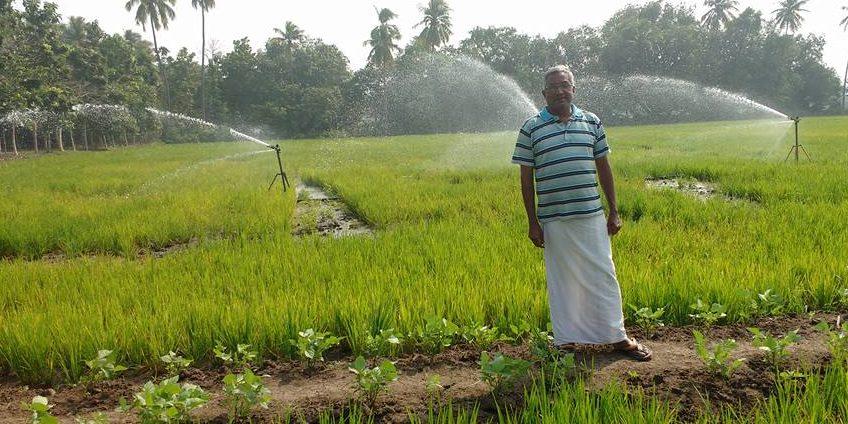
Soybeans are one of farming’s greatest global success stories—and I’d continue to grow them today, if only my government would give me access to a basic technology.

Today in India, I’m forbidden from using a crop-protection tool that farmers elsewhere take for granted. Because of this restriction, I had to abandon soybeans in the middle of a global revolution.
My experience is a cautionary tale, and it points to a major threat to agriculture in the 21st century.
A new report from the American Enterprise Institute, a think tank in Washington, D.C., describes the concern: “Ill-advised government policies may severely limit the capacity of scientists, entrepreneurs, and farmers to sustain and increase current levels of agricultural productivity and output.”
For me this is not an abstract idea in a random paper written by scholars. It’s a lesson from my life.
In 1961, when I was three years old, farmers around the world produced less than 30 million tons of soybeans. Today, this figure approaches 400 million tons, according to the AEI report, which cites data from the UN Food and Agriculture Organization (FAO).
That’s a growth rate of nearly 1,200 percent.
Other major crops enjoyed their own achievements during the same 60-year period. Corn production grew by 460 percent. Cassava increased by more than 360 percent. Rice and wheat each improved by about 260 percent. Among the six major crops studied by Barry K. Goodwin and Vincent H. Smith, only millet saw minimal returns, with an uptick of about 20 percent.
These feats of science and technology allowed farmers not only to keep up with an exploding human population, but also to boost calorie consumption. As the number of people soared from about 3 billion in the early 1960s to more than 8 billion today, the number of calories available from the six major crops for human and livestock consumption as well as biofuels boomed, from an average of 2,350 per person to 4,130 per person today.
“These stunning numbers are a testament to the critical roles of research, innovation, adoption, adaptation, and entrepreneurship in public and private agricultural research institutions,” write the authors of the AEI report.
Much of this triumph today is known as the Green Revolution, which took advantage of new agricultural technologies to reduce hunger and malnutrition at a time when many doomsayers predicted the catastrophe of a so-called “population bomb.”
I participated in the Green Revolution. As my yields went up, poverty and malnutrition in India declined. I’ve seen it with my own eyes.
Yet something happened as the Green Revolution evolved into the Gene Revolution in the 1990s and into our century. Many countries in the developing world, including mine, rejected the full promise of biotechnology. Listening to political activists rather than scientists, public officials prohibited farmers from using GM technology, even as our colleagues (and competitors) in North and South America and elsewhere embraced this innovation and watched their productivity surge.
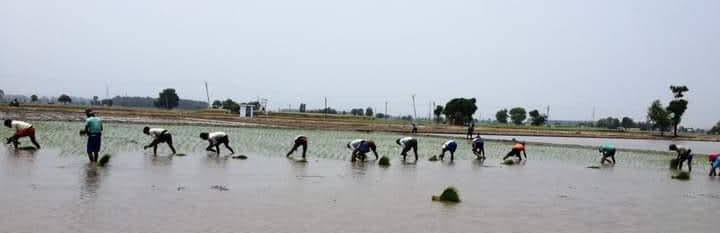
I’ve grown rice my whole life as a farmer. When I started in 1986, we had some high-yielding varieties, a few of which still perform well today. Hybrid rice became available in 1993. We’ve also cheered the advent of molecular marker-assisted varieties, such as a submergence-tolerant rice that helps me cope with flooding, drought, and other unpredictable weather events.
That’s progress.
Soybeans, however, were a struggle. I grew them between 1990 and 1995—but I had to give up because the pests were so bad. Armyworms and pod borers devastated our fields. Controlling them was too costly.
Yet science offered a solution: GM technology that allows soybeans to carry a natural resistance to pests. We watched farmers who plant GM crops flourish—but here in India, we’re not allowed to use GM soybeans. Policymakers have mostly banned this technology. Rather than joining the Gene Revolution, we’ve watched it from the sidelines.
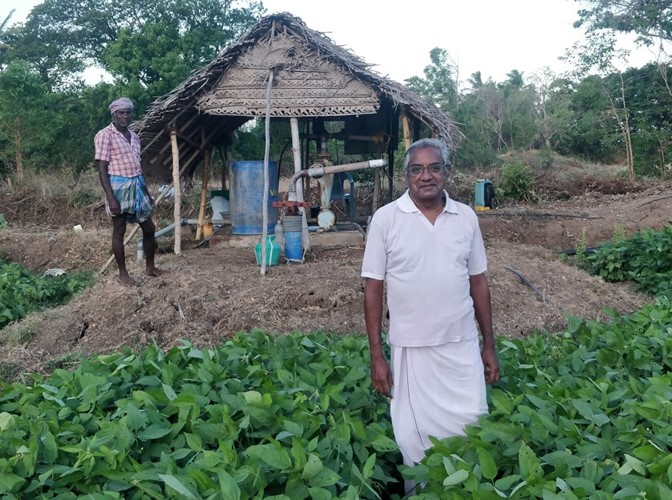
I face many challenges on my farm. After years of growth, productivity has plateaued. Profits have started to decline, due to rising labor costs and market mismatches in which supplies often outstrip demand. Even worse are the climate patterns, which have shifted from predictable to erratic. I once knew what to expect from cyclic monsoons. Now we face unseasonal rains, extreme heat, and the arrival of new pests.
Agriculture requires adaptation, and I’ve done my best to change with the times—but it would be easier and better if farmers like me could gain access to the latest technologies. Science offers them, but my government prohibits them.
The authors of the AEI report warn that bad choices could lead to agricultural “atrophy.”
If we don’t solve this problem in India and elsewhere, the success story of agriculture in the 20th century will degenerate into a new tale of missed opportunity.