The massive rainfall in central Europe in September left in its wake a trail of destruction: catastrophic flooding, billions of dollars in losses, and at least two dozen deaths.
This is a major natural disaster, caused by a storm that developed over the Mediterranean Sea and surged inland. At the time of this writing, the region is still reeling. My heart goes out to everyone affected.
As we recover on my farm in Romania and beyond, we must look for lessons—and there’s an important one for agriculture. The recent flooding exposed the huge difference between sustainable and unsustainable farming, and it revealed that no-till agriculture and cover crops can play a significant role in the future of resilient crop production.
I’m an accidental but intentional Romanian farmer. I was born into an Irish farming family, but I inherited none of its land. This apparent misfortune may have been my lucky break because it forced me to look for prospects elsewhere. After managing rented farms in Ireland, I became involved with large-scale farming syndicates, and with partners and investments we built large-scale operations in Argentina, Australia, and the United States.
In 2012, I learned of a chance to farm in northeastern Romania, known for its rich black soil. The land was affordable. Romania’s membership in the EU guaranteed the rule of law. I worked with a team to create a business plan, confirmed investors and together we built and are running today a farming operation that covers almost 50,000 acres, employing 130 people.
Since the beginning, we’ve faced many tests, such as the ongoing war in Ukraine, which borders Romania.
Yet our biggest challenge goes deeper into history, back to the Cold War and the legacy of Communist rule in Romania. This was an unnatural disaster that involved the government’s confiscation of farms in the 1940s as well as a massive redistribution following the collapse of the Soviet Union and its vassal regimes in 1989.
One result is that today, Romania farmland is comprised of oddly shaped strips. This was Communism’s final act of gross malevolence and stupidity—slowly giving the land to everyone in small strips, wanting nobody wealthy or powerful. One of our major tasks as farmers is to buy, rent, and swap these land strips in creative ways so that we can consolidate to create larger fields.
This is a nightmare of management. We’d prefer to devote ourselves to growing food.
Yet it also has provided a fascinating case study in the advantages of sustainable agriculture because we can observe the enormous gap between neighboring fields.
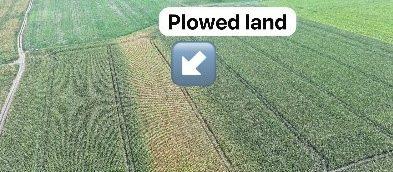
The easiest way to see the difference is to look at photographs of fields that flourish alongside fields that suffer. The no-till hectares stand out like oases in the desert of plowed strips.
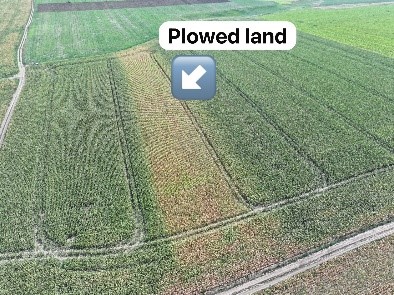
The images are striking, but it takes words to explain what happened.
For the last 70 years, our area has received an annual average of about 21 inches of rain. That’s low by some standards, but enough to grow good crops here, especially when the rain arrives at the right time.
Over the last three years, however, we’ve gotten only 12 to 15 inches. That qualifies as a drought, and it has been made more ferocious by scorching temperatures, causing heat stress in crops.
Everything depends on the soil, in both good times and bad. The problem with traditional ploughing is that it damages the soil structure. The constant disruption of the ground leaves the topsoil vulnerable to runoff. Below the topsoil, ploughing compacts the dirt, limiting its ability to soak up and retain moisture.
During a drought, plants in plowed fields wilt and die. Those in no-till fields struggle but survive.
Our latest challenge, of course, was the opposite extreme: a deluge of water. South of us, farms faced 10 inches of water in 36 hours and endured untold damage. Our fields were not hit as hard—we had five to seven inches of rain in about 72 hours—but we had no runoff due to no-till and cover crops.
Despite this success, our farms are still works in progress. You don’t fix decades of Communist mismanagement in a single season, or even in several seasons. It takes hard work, a clear vision, and a lot of patience.
Yet we’re seeing the positive results of no-till in everything from an explosion in the population of earthworms to the way we endured the floods of September.
Our fields are doing well, even in times of trouble. They’re only going to improve as we continue to apply modern agricultural practices.
Farmers always will face problems—but those who choose the best sustainable approaches will improve their resilience, continue to adapt, and recover from disasters.